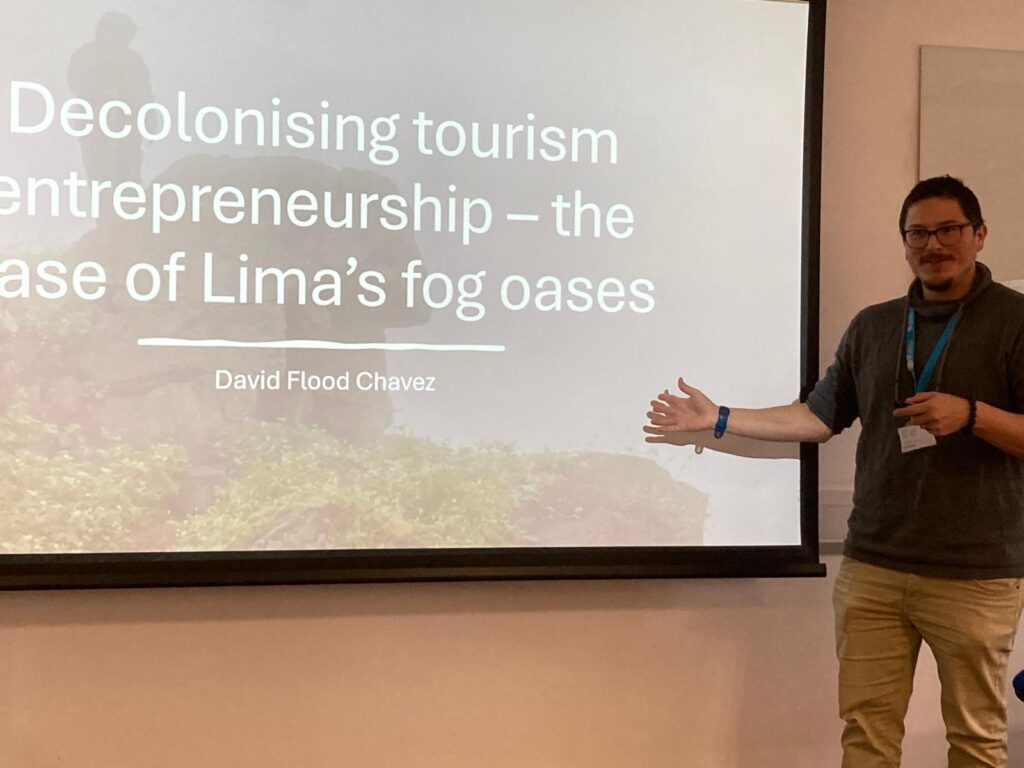
Dr David Flood Chavez is a teacher, researcher, and one of the newest members of the University of Worcester’s academic staff. Although he has lived in the UK for the past eight years, his research has taken him across the world, from Peru to India and Brazil. These experiences have shaped his broad understanding of sustainability and his passion for inspiring the next generation. He passionately believes sustainability must be fought for.
Roots in Peru with the Beginning of a Sustainability Journey
Dr. Flood Chavez began his academic journey in Peru, completing his Bachelor’s degree in forestry in 2004. During this time, he developed an interest in conservation, which marked his first steps into sustainability. This interest continued into his Master’s, where he wrote a dissertation on grassroots organisations in Lima’s urban areas. Later, he completed his PhD, examining sustainability transitions in tourism in Australia.
He explains that sustainability should not be seen only as an environmental issue. While nature is important, sustainability is also shaped by social and economic factors. Governments and grassroots organisations both play a role. “Sustainability is not something we can take for granted but something that needs to be achieved,” he says.
Sustainability, Inequality, and Power
Much of Dr. Flood Chavez research focuses on the Global South, where sustainability is closely linked to inequality, violence, and corruption. Illegal activities often harm communities and control land and resources. However, but these communities are not powerless.
Grassroots organisations often act as a form of resistance, helping communities protect their land and environment. Looking through a colonial lens helps explain why sustainability in the Global South is different from Europe. “A colonial lens allows us to see how reality is very different to what we see in Europe,” he explains.
His research shows that sustainability in these regions is shaped by history, power and social struggle. Violence and corruption must be recognised to understand how sustainability works in these places and how sustainability transitions in the Global South often emerge in response to these power imbalances.
Sustainable Tourism and the Pandemic
Dr. Flood Chavez PhD looked at how tourism destinations in Australia changed over time.Using national newspaper databases, he showed that tourism developed in response to political and social changes. (His second paper applied the Multi-Level Perspective (MLP), to better understand these transitions of sustainability.)
When asked about the impact of Covid 19, he explains that scholars had two views. Some believed tourism would quickly return to unsustainable patterns. Others, including Dr. Flood Chavez, saw an opportunity for change. The lockdown allowed people to see nature recover and increased awareness of human impact on the environment.
He also notes that local communities are increasingly protective of tourists areas. Pride in their hometowns, encourages locals to protect these places while welcoming visitors, creating chances for more sustainable tourism.
Research Across the Globe
Dr. Flood Chavez research has taken him far beyond the UK and Peru. In 2023 and 2024, he visited India’s Sangla Valley to study the effects of natural disasters on local livelihoods, agriculture and tourism. In 2025, he participated in a workshop in Brazil that sparked an new interest in soy-based biofuels for industry.
Looking ahead, he hopes to build research connections in Canada and Europe. He also emphasises traveling in ways that match his sustainability values.
A new Academic Home and Hopes for the Future
After teaching in northern England, Dr. Flood Chavez joined the University of Worcester because it values both teaching and research. One of his upcoming projects is a new module on environmental justice, political ecology, and the relationship between society and the environment.
“Being critical about sustainability is not the same as criticizing sustainability,” he says.
Dr. Flood Chavez hopes his work will lead to positive change. He is currently writing a paper challenging the idea that European models apply everywhere. For him, sustainability works on two level: personal and collective. Individual choices matter, but real change happens when people work together.
Publication of interest: https://eprints.worc.ac.uk/15728/