
Authors: Student researchers Shravya Bhogaraju, Camden Brayton, Alyssa Howland, Shrikar Jemolla, Braden Moriarty.
Have you ever seen the Fairtrade logo on a coffee cup or a chocolate bar?
Most young people in the United Kingdom recognise the logo. But here’s the catch: recognising Fairtrade doesn’t mean engaging with it.
A group of student researchers set out to explore this gap during our project with the Fairtrade Foundation while working at the University of Worcester. We wanted to understand not just what young people know about Fairtrade, but why that awareness doesn’t always translate into action.
What we did
To get a clearer picture, we connected with young people across Worcester and beyond. We conducted surveys with university students, college students, and secondary school students, and interviewed educators who run Fairtrade workshops and campaigns.
Our goal was simple:
Find out what the youth know, what they feel, and what motivates them to get involved with Fairtrade.
From Awareness to Action
What we found was both encouraging and a bit surprising.
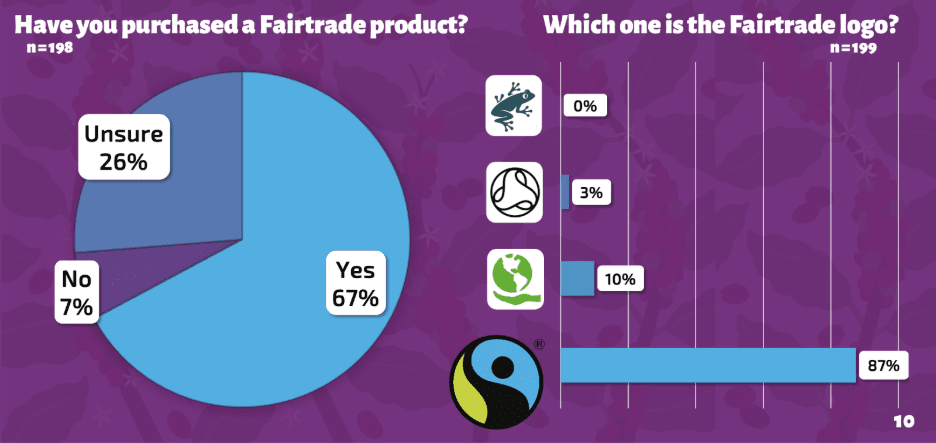
Fairtrade has a strong visibility as around 87% of young people we surveyed have recognised the logo. But when it came to deeper understanding and clear engagement, there was a clear drop-off.
71% of respondents believed that young people can make a difference, however 30% of respondents reported regularly engaging in activism or Fairtrade-related activities.
So, what’s getting in the way?
Some of the most common barriers we heard about were surprisingly practical:
- The higher cost of Fairtrade products
- Being unsure if their actions make an impact
- Limited time, especially for students
- Not knowing how to get involved beyond simply buying products
The interest is there, but the pathway to engagement isn’t always clear.
What actually works
Through our interviews and research, one thing stood out: interactive experiences make a difference.
Activities like workshops, discussions, and even tasting Fairtrade products help turn abstract ideas into something tangible. People are far more likely to engage with when they can experience the impact, rather than just hear about it.
But there’s a catch; engagement often stops after these events.
Many participants leave interested, but without clear steps, that interest fades.
Bridging the Gap
This led us to a key insight: young people don’t necessarily want large-scale activism. They want ways to get involved that actually fit into their everyday lives.
So, we came up with a few recommendations:
- Private Activism – making Fairtrade part of everyday life through small choices like what you buy, how you live, and even just talking about it with friends and family
- Sister Schools/Communities – connecting with young people around the world to hear real stories and see the impact of Fairtrade first-hand
- Incentivising Student Involvement – giving students opportunities like volunteering and internships to build experience while making a difference
- Social media – creating engaging content to connect with the youth of today
Final Thoughts
So, what is the takeaway?
Young people care about social justice and want to make a difference. The challenge is turning that interest into action in a way that feels realistic and accessible.
Student researchers discovered that engagement does not need to be complicated; it just needs to feel possible.
Fairtrade is not something you just recognise on a label. It’s a part of something bigger and this starts with the small actions we take every day.

Read our full report here
Watch the students present their research